
- February 27, 2026
- By: admin
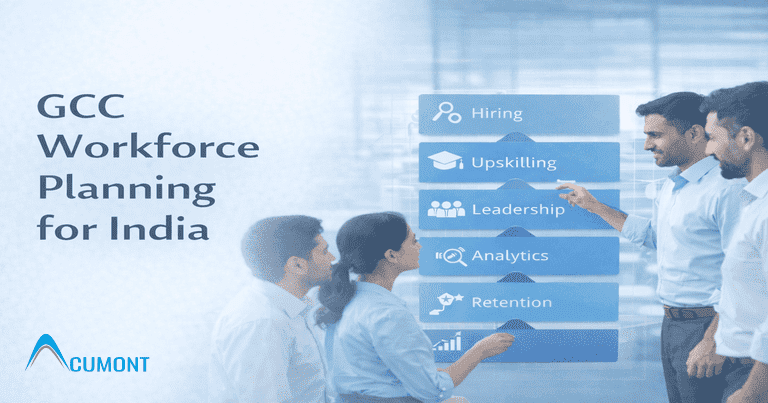
GCC Workforce Planning for India: Step-by-Step Strategy Guide
In a rapidly evolving global business landscape, Global Capability Centers (GCCs) are no longer just cost-efficient delivery hubs. They are strategic capability hubs driving innovation, automation, analytics, and enterprise-wide decision-making for multinational corporations and global enterprises.
As the GCC landscape across India’s GCC ecosystem continues to expand, workforce development has emerged as a strategic differentiator, especially for organizations building a future-ready GCC designed for long-term value creation and resilience.
This blog outlines a strategic and actionable framework for GCC workforce planning and workforce development, designed for leaders launching a new GCC, scaling existing India GCCs, or strengthening workforce capabilities across India’s evolving business environment.
Why Workforce Planning Matters for GCC Success?
For global enterprises, workforce planning goes beyond traditional workforce expansion or hiring models. It requires strategic workforce planning aligned with enterprise business priorities, digital transformation initiatives, and AI-led operating models.
It involves building a structured and adaptive workforce framework with:
- ● The right technical skills
- ● Leadership development pathways
- ● Organizational readiness
- ● Culture alignment
- ● Future-ready workforce capabilities
The scale of this shift is evident in the data:
- ● India’s GCC workforce is projected to grow significantly from approximately 2.4 million today to approximately 3.46 million by 2030 as GCCs integrate AI, automation, and digital transformation at scale.
- ●GCCs already account for more than half of global capacity centres globally, with India hosting over 1,700 centres roughly 53% of the world’s total.
- This transformation signals that successful GCCs are no longer extensions of a traditional workforce model. They are agile, scalable, and change-ready strategic hubs accelerating enterprise-wide impact.
Defining GCC Workforce Development
Workforce development in global capability centres is fundamentally different from conventional talent acquisition.
It encompasses building structured workforce capabilities that address:
- ● Strategic workforce planning aligned with GCC mission
- ● Talent development and structured upskilling
- ● Leadership development and leadership depth
- ● Performance calibration supporting organizational performance
- ● Talent retention and internal mobility frameworks
- ● Integrated tools supporting decision-making and automation initiatives
In other words, it is the end-to-end architecture of building people for the future, not simply filling roles. In India’s GCC landscape, this shift is critical to close skill gaps, address capability gaps, and create future-ready operating models that support multinational enterprise growth.
7-Step Framework to Develop GCC Workforce Capability
This structured framework helps GCC leaders build high-impact GCC teams aligned with global strategy and local talent realities.
- Clarify Strategic Capability Goals
Every strategic GCC must define the specific capabilities it intends to build:
- ● AI-led product development
- ● Advanced analytics and automation initiatives
- ● Finance transformation
- ● Project-based digital programs
- ● Shared services modernization
Clear capability definitions ensure workforce development aligns with enterprise business priorities and long-term value creation.
- Design Workforce Structure & Roles
Modern GCCs require hybrid workforce models that continue:
- ● Core technical teams (e.g., engineering, analytics)
- ● Support functions (e.g., HR operations, finance)
- ● Strong Leadership layers
- ● Agile project-based squads
- ● Capability clusters
(Entry level → Specialist → Expert → Lead)
This design avoids duplication, strengthens decision-making clarity, and supports organizational performance.
- Build a Strategic Talent Acquisition Blueprint
Hiring for GCCs must reflect the evolving talent landscape across India’s GCC ecosystem. Strategic hiring models should include:
- ● Campus and early-career talent pools
- ● Lateral hiring for niche technical skills
- ● Leadership hiring aligned with enterprise strategy
- ● Diversity initiatives strengthening innovation
As AI, automation, and analytics reshape the GCC landscape, proactive workforce readiness becomes essential to retain talent and build sustainable teams.
- Embed Continuous Upskilling & Development Programs
Future-ready GCCs invest heavily in structured upskilling and training programmes.
This includes:
- ● Internal certifications
- ● AI and automation training
- ● Cross-functional rotations
- ● Leadership development tracks
- ● Integrated learning platforms
Continuous talent development ensures GCC environments remain adaptive, agile, and aligned with evolving business needs. Rather than reacting to capability gaps, leading GCCs accelerate skill evolution to stay competitive.
- Leadership Development & Organizational Alignment
Strong leadership is foundational to successful GCCs. Organizations must:
- ● Develop mid-management leadership depth
- ● Build hybrid leaders bridging global and India context
- ● Align culture with enterprise standards
- ● Strengthen change-ready leadership behaviours
Leadership development directly impacts workforce resilience, talent retention, and long-term competitive advantage.
- Performance, Analytics & Automation Metrics
High-performing GCCs rely on data-driven performance frameworks supported by analytics and automation. Measurement must include:
- ● Time-to-productivity
- ● Skill advancement metrics
- ● AI-led productivity benchmarks
- ● Impact against enterprise KPIs
These integrated tools enhance decision-making and reshape operational efficiency across India’s GCC environments.
- Retention & Employee Experience Strategy
Retention is a strategic workforce priority. Strategic retention initiatives include:
- ● Career mobility and internal mobility programs
- ● Structured development programs
- ● Transparent role clarity
- ● Competitive benchmarking
Retention reduces operational disruption, strengthens workforce continuity, and supports long-term organizational resilience.
Common Pitfalls in GCC Workforce Planning
Even well-funded GCCs in India can underperform if workforce planning lacks structure.
Common risks include:
- ● Hiring without defined skill roadmaps
- ● Copying global models without adapting to India’s talent landscape
- ● Ignoring leadership development
- ● Treating workforce development as HR rather than enterprise strategy
- ● Failing to align workforce capabilities with evolving business goals
Avoiding these pitfalls ensures GCCs evolve into high-performing strategic capability hubs.
India’s GCC Environment: Strategic Opportunity
India continues to be a dominant global destination for GCCs due to a combination of strategic advantages and emerging capabilities:
- ● A vast and highly skilled talent pool, with growing specialization in digital technologies and advanced domains.
- ● Cost efficiency and language proficiency, providing both operational and communication advantages for global clients.
- ● Expanding hub capacity beyond traditional metropolitan cities, allowing GCCs to scale efficiently and tap into diverse talent markets.
- ● Rapid development in high-value capabilities, including AI, cloud computing, cybersecurity, and data analytics.
These factors, combined with India’s evolving business ecosystem, highlight why global companies are increasingly viewing workforce development and capability planning as strategic priorities rather than purely operational necessities.
GCCs that proactively leverage these opportunities can build resilient teams, strengthen innovation outcomes, and ensure long-term operational maturity in a highly competitive global environment.
Conclusion
In today’s evolving business environment, GCC success is defined by workforce strength, not cost arbitrage alone.
Strategic GCC workforce planning empowers organizations to:
- ● Build high-impact GCC teams
- ● Accelerate AI-led transformation
- ● Strengthen organizational performance
- ● Drive enterprise-wide value creation
- ● Create future-ready global capability centres
Acumont partners with multinational corporations and global enterprises to design scalable, adaptive, and future-ready workforce models across India GCCs.
Through strategic workforce planning, talent development, leadership depth building, and integrated hiring models, Acumont helps organizations reshape their GCC environments into resilient, high-performing strategic hubs built for long-term impact.
FAQs
What is workforce development in a GCC context?
It is structured planning and management of skills, leadership, performance frameworks, and career pathways, going beyond simple hiring.
How do you build a workforce strategy for a new GCC?
Align capability goals with business objectives, define clear roles, design a talent acquisition plan, and embed continuous learning and upskilling programs.
What are the main challenges in GCC workforce planning?
Common issues include missing skill roadmaps, applying HQ models without adaptation, gaps in mid-management, and treating workforce planning as a purely HR function rather than a strategic priority.
What skills are most in demand for GCC workforce development?
High-value skills include AI, data analytics, cloud computing, cybersecurity, digital product development, and leadership capabilities that effectively bridge global standards and local business context.
