
- July 18, 2025
- By: admin
Contract Staff vs Permanent Staff: What’s Right for Your Business?
Struggling to decide whether to hire full-time employees or bring in contract workers for urgent needs?
With workforce dynamics shifting rapidly, this decision can directly impact both your project outcomes and long-term growth. This makes it essential for HR professionals and business leaders to clearly understand the distinctions between contract employees and permanent employment models.
According to the 2024 Robert Half Hiring Trends Report, 70% of executives aim to increase their use of temporary and contract workers, highlighting a shift toward flexible workforce models. This comprehensive guide will help you navigate the difference between permanent and contract staffing, analyze costs, and determine which approach aligns best with your business objectives.
Understanding the Difference: Contract vs Permanent Staffing Models
What is Contract Staffing?
Contract staffing involves hiring professionals for predetermined periods or specific projects. These workers bring specialized skills to address immediate business needs without long-term commitments. With 57% of companies active in the temporary staffing space (American Staffing Association), this model continues to see widespread adoption.
What is Permanent Staffing?
Permanent staffing refers to hiring full-time employees who become integral parts of your organization’s long-term structure. These team members receive comprehensive benefits, job security, and contribute to long-term company growth and culture development.
The contractor vs permanent employee difference extends beyond tenure, encompassing legal obligations, tax implications, benefits provision, and cultural integration levels.
Cost Comparison
Financial Impact Analysis
When evaluating the contract staff vs permanent staff cost comparison, consider both immediate expenses and long-term commitments:
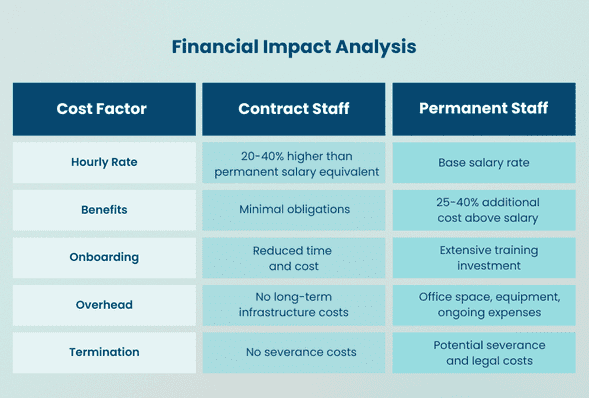
According to Toptal’s Employee Cost Analysis, government contract roles may have cost multipliers ranging from 1.5 to 2.5, reflecting additional benefit and compliance costs.
Pros and Cons of Each Staffing Model
Contract Staffing Advantages
Flexibility and Scalability: Contract staffing offers unparalleled workforce agility. 41% of companies expect to increase their use of Contingent Workers, underlining the shift toward flexible, project-based employment models.
Specialized Expertise: Contract professionals bring cutting-edge skills and diverse industry experience, accelerating project timelines and improving outcomes.
Reduced Administrative Burden: Eliminate HR complexities including benefits administration and long-term career development planning.
Permanent Staffing Advantages
Institutional Knowledge: Permanent employees develop comprehensive understanding of company processes, culture, and long-term objectives.
Cultural Integration: Full-time employees demonstrate higher loyalty and contribute to team cohesion and organizational stability.
Long-term ROI: While initial costs are higher, permanent employees often deliver increasing value over time through improved efficiency and innovation.
Key Challenges
Staffing Model | Primary Challenges |
Contract | Higher per hourly costs, limited cultural integration, knowledge gaps when contracts end |
Permanent | Significant financial commitments, lengthy recruitment processes, difficulty adapting to changing skill requirements |
How to Choose staffing model?
Contract Staffing: Ideal Scenarios
Project-Based Work: When to hire contract staff vs permanent becomes clear for well-defined projects with specific timelines and deliverables.
Urgent Skill Requirements: Contract staff can often start immediately, bypassing lengthy recruitment processes—particularly valuable for technical roles or crisis management.
Market Testing: Contract arrangements allow experimentation with new positions before permanent commitments.
Permanent Staffing: Strategic Advantages
Core Business Functions: Permanent staff should handle core competencies and strategic initiatives requiring deep business understanding.
Leadership Roles: Senior positions requiring cultural leadership and strategic decision-making benefit from permanent employees with substantial company investment.
Customer-Facing Positions: Roles involving direct customer interaction benefit from consistent relationship building and brand representation.
Hybrid Staffing Strategy: The Smart Alternative
Combining Flexibility with Stability: Two thirds of employers are planning to increase their use of contract professionals, but the most effective approach often involves a hybrid model combining both staffing types.
Optimal Hybrid Structure:
- 60-70% permanent staff for core functions
- 20-30% contract staff for specialized projects
- 10-20% flexible capacity for seasonal needs
Implementing a Hybrid Staffing Strategy:
Building an effective hybrid workforce requires a structured approach that balances agility with long-term continuity. Acumont supports this model by focusing on:
Strategic Workforce Planning: Aligning staffing decisions with business cycles, resource demands, and projected growth.
Integrated Team Structures: Enabling contract professionals to collaborate smoothly with permanent staff.
Flexible Engagement Models: Offering adaptable staffing frameworks that respond to shifting organizational priorities.
Consistent Quality Standards: Maintaining uniform performance benchmarks across both contract and full-time roles.
Making the Right Choice: Decision Framework
Quick Assessment Guide
Factor | Choose Contract | Choose Permanent |
Timeline | Short-term project (< 12 months) | Ongoing role (> 12 months) |
Skills | Specialized/niche expertise | General business capabilities |
Budget | Project-based budget | Long-term investment capacity |
Integration | Task-focused work | Culture/team integration important |
Knowledge | External expertise needed | Internal knowledge building required |
Industry Trends and Future Outlook
As per Spherical Insights’ Market Research Report, the contract/temporary staffing market was valued at USD 90 billion in 2021 and is projected to grow to USD 130.20 billion by 2030, at a CAGR of 9.06%.
In addition, according to Conexis VMS’s 2023 workforce analysis, there were 36.6 million independent contractor roles in the U.S., reflecting massive growth in the contingent workforce. Many of these professionals are self-employed and prefer project-based flexibility over long-term commitments.
Conclusion: Strategic Staffing for Business Success
There’s no universal answer when it comes to staffing. While contract staffing brings flexibility, cost control, and access to specialized skills, permanent employees contribute to culture, long-term productivity, and organizational stability.
As market conditions shift, the most resilient companies are adopting hybrid staffing models, blending permanent and contract talent to stay agile, cost-efficient, and future-ready.
By assessing your project goals, timelines, and team structure, you can create a staffing strategy that not only supports current operations but also scales with your long-term vision.
Learn how flexible staffing models can align with your business goals, whether you need long-term stability or project-based agility.
Contact Acumont today to build your optimal workforce strategy.
Frequently Asked Questions
What is the main difference between contract and permanent staff?
The primary difference lies in employment duration and commitment. Contract staff work for predetermined periods with specific deliverables, while permanent staff are long-term employees with ongoing responsibilities and comprehensive benefits.
Is contract staffing more cost-effective?
It can be for short-term needs, as you avoid long-term benefit and training costs. However, salary over time may even out depending on retention and turnover rates.
Can contract workers become permanent employees?
Yes, many companies use contract-to-permanent arrangements to evaluate candidates before making long-term commitments, allowing both parties to assess fit.
Why do companies prefer contract staff?
Because employees may need to scale quickly or respond to market changes, contract staffing provides agility and rapid onboarding without major commitments.
Ready to optimize your staffing strategy? Acumont’s expertise in both contract and permanent staffing solutions can help you build a workforce that drives results. Contact us today to discover how we can support your business growth across India, APAC and US Markets.
