
- July 31, 2025
- By: admin
Recruitment Strategy Plan: A Complete Framework for Scalable Hiring
Hiring top talent isn’t just harder, it’s also more competitive, time-consuming, and expensive than ever. According to ManpowerGroup’s 2023 Talent Shortage Survey, 77% of employers worldwide are struggling to fill open roles, the highest talent gap in 17 years. While recruitment process efficiency remains a pressing concern, companies that adopt structured recruitment strategies are more likely to improve hiring efficiency and long-term workforce performance.
Whether you’re a hiring manager streamlining your hiring process, a talent acquisition head scaling your team, or a founder building your first structured framework, this comprehensive guide provides you with a proven recruitment strategy plan that delivers measurable results.
The Hidden Cost of Poor Recruitment Planning
Before diving into solutions, it’s crucial to understand what’s at stake. According to industry research, the cost of a bad hire can range from 30% to over 200% of the employee’s annual salary, depending on the role and level of seniority. Think of the cost, not just money, but time lost, productivity drained, and morale disrupted across your team.
The modern recruitment landscape presents unique challenges that make strategic planning even more critical. Talent scarcity has intensified competition, with software engineers receiving an average of 3-5 job offers simultaneously. Meanwhile, potential candidates now expect transparent communication, streamlined application processes, and clear alignment with company values throughout their journey.
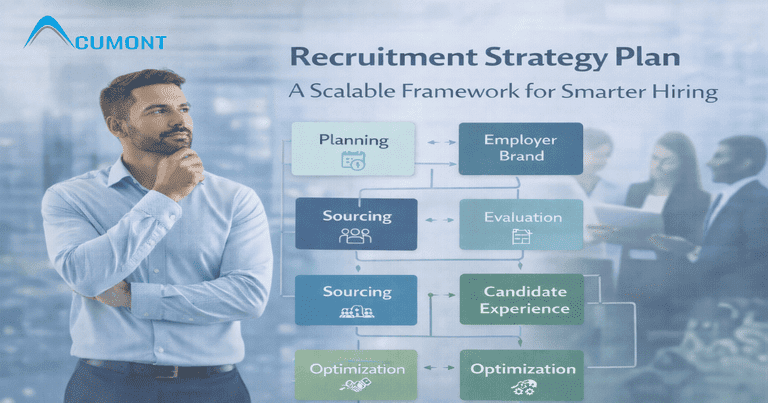
6 Pillars of a Scalable, High-Impact Hiring Strategy
A comprehensive template for recruitment strategy rests on six fundamental pillars that work together to attract, evaluate, and secure top talent.
- Strategic Foundation and Planning
This forms the strategic cornerstone of successful recruitment planning and includes:
- • Aligning recruitment goals with business objectives
- • Conducting workforce planning to identify skill gaps
- • Establishing realistic budgets and timelines
- • Syncing hiring schedules with business cycles
- Employer Branding Excellence
Companies with strong employer brands enjoy remarkable advantages, including 50% more qualified applicants and 28% lower turnover rates (LinkedIn, 2023). Focus on:
- • Communicating your unique value proposition
- • Showcasing authentic company culture
- • Highlighting growth opportunities
- • Featuring genuine employee testimonials
- Multi-Channel Sourcing Strategy
Reduce dependency on single recruitment channels while improving candidate quality:
|
Sourcing Channel |
Best Application |
Estimated Cost Per Hire |
Time Investment |
|
Employee Referrals |
Cultural fit candidates |
$1,000 – $1,800 |
Low |
|
Professional Networks |
Passive candidates |
$2,500 – $4,000 |
Medium |
|
Job Boards |
Volume hiring needs |
$1,800 – $3,500 |
Low |
|
Social Media |
Employer branding |
$1,000 – $2,500 |
High |
|
Recruitment Agencies |
Specialized roles |
$7,500 – $15,000+ |
Low |
|
Campus Recruiting |
Entry-level positions |
$2,000 – $4,000 |
High |
Notes:
- • Social media costs vary based on campaign size and conversion rate; cost per applicant is low, but cost per hire can scale up.
- • Agency fees typically range from 15-25% of annual salary.
- • Data is sourced and validated from Glassdoor, GoRemotely, SmartRecruiters, Zippia, and LinkedIn Talent Solutions.
- Structured Evaluation Process
To ensure fairness and consistency across all hiring decisions, focus on the following key practices:
- • Implement competency-based interviewing
- • Assemble diverse interview panels to reduce bias
- • Establish structured scoring systems
- • Conduct thorough reference verification
- Candidate Experience Optimization
Consistently shape your employer brand through every candidate interaction by focusing on the following touchpoints:
- • Mobile-optimized applications (under 10 minutes)
- • Regular communication updates every 48-72 hours
- • Professional and informative interview experiences
- • Constructive feedback regardless of outcomes
- Continuous Improvement Framework
Enable continuous data-driven strategy evolution through the following critical practices:
- • Key performance indicator tracking
- • Regular quarterly reviews and adjustments
- • Stakeholder feedback collection
- • Market analysis of competitive landscapes
Sample Recruitment Strategy Plan: Mid-Sized SaaS Company Example
Wondering what this looks like in real life? Let’s explore a sample recruitment strategy for a fast-growing, mid-sized SaaS company planning a 30% headcount increase in 6 months, with a $400,000 budget.
Company Profile Overview
The company operates in the B2B customer relationship management space, currently employing 100 people with an ambitious goal to hire 30 new employees within six months. The company has allocated $400,000 for this expansion, focusing on key roles including 12 Software Engineers, 8 Sales Representatives, 6 Customer Success Managers, and 4 Marketing Specialists.
Phase 1: Strategic Foundation (Month 1) begins with comprehensive planning and infrastructure development.
Budget Allocation ($400,000 total):
- • Internal recruiting team expansion: $80,000 (1 additional recruiter)
- • External recruitment agencies: $120,000 (30% of hiring needs)
- • Job description tools and job boards: $40,000
- • Employer branding initiatives: $80,000
- • Interview and assessment tools: $20,000
- • Contingency fund: $60,000
Key Activities:
- • Conduct workforce gap analysis for each role
- • Establish hiring timelines with department heads
- • Launch career page improvements
- • Implement employee referral program ($300 bonus per hire)
Phase 2: Execution Strategy (Months 2–4) focuses on aggressive hiring implementation with specific monthly targets:
Monthly Hiring Targets:
- • Month 2: 8 hires (4 Engineers, 2 Sales, 2 CS Managers)
- • Month 3: 12 hires (5 Engineers, 4 Sales, 2 CS Managers, 1 Marketing)
- • Month 4: 10 hires (3 Engineers, 2 Sales, 2 CS Managers, 3 Marketing)
Sourcing Strategy Breakdown:
- • Employee referrals: 40% (proven effectiveness in cultural fit)
- • LinkedIn and job boards: 30% (active candidate targeting)
- • Recruitment agencies: 20% (specialized positions)
- • Social media and networking: 10% (candidate sourcing and employer brand building)
Phase 3: Completion and Optimization (Months 5–6) involves:
- • Finalizing remaining hires
- • Conducting comprehensive process reviews
- • Documenting effective procedures for future use
- • Beginning pipeline development for next hiring phase
Expected Outcomes:
- • Complete all 30 hires within six months
- • Maintain 25-day average time-to-fill (vs. 35+ industry average)
- • Keep cost-per-hire at $13,333 (below $15,000 industry benchmark)
- • Achieve 90%+ retention rates after one year
Implementation Framework for Your Organization
Creating your custom recruitment strategy begins with comprehensive needs assessment:
Step 1: Conduct Needs Assessment
- • Analyze current team composition and skill gaps
- • Review historical hiring data and trends
- • Evaluate budget constraints and approval processes
- • Assess existing recruitment resources
Step 2: Set SMART Goals Examples of effective goal setting:
- • “Hire 5 Python developers within 3 months”
- • “Achieve 85% first-year retention rate”
- • “Fill 90% of positions within 30 days”
Step 3: Develop Employer Value Proposition Your EVP should include:
- • Compensation philosophy and market positioning
- • Career development and growth programs
- • Work environment culture and flexibility
- • Mission alignment and social impact initiatives
Step 4: Choose Your Sourcing Strategy Focus on 3-4 channels that align with your needs:
- • Always include employee referrals (highest quality candidates)
- • Add job boards for volume hiring
- • Use social media for brand building
- • Consider agencies for specialized positions
Step 5: Standardize Interview Process
- • Develop structured questions for each role
- • Train interviewers to reduce bias
- • Create scorecards for objective evaluation
- • Establish thorough reference checking procedures
Measuring Recruitment Success and Avoiding Costly Mistakes
Effective measurement focuses on key performance indicators that matter most to your organization’s success:
|
Metric Category |
Key Indicators |
Target Benchmarks |
|
Efficiency |
Time-to-fill, Cost-per-hire |
<30 days, <$15,000 |
|
Quality |
Performance ratings, Retention |
>4.0/5.0, >85% |
|
Experience |
Candidate satisfaction |
>4.5/5.0 |
|
Pipeline |
Application volume, Conversion rates |
Industry +20% |
Common mistakes include reactive hiring approaches where recruitment begins only after a vacancy appears, overemphasis on technical skills while ignoring cultural fit, inconsistent candidate communication damaging employer brand, and neglecting internal mobility opportunities that could fill positions more effectively and affordably.
Avoid These Common Pitfalls:
- • Reactive Hiring: Start recruiting before you desperately need people
- • Skills-Only Focus: Balance technical abilities with cultural fit
- • Poor Communication: Keep all candidates updated throughout the process
- • Ignoring Internal Talent: Consider current employees for promotions first
Your Path Forward
Successful implementation requires systematic execution:
Implementation Timeline:
- • Week 1-2: Audit current processes and identify gaps
- • Week 3-4: Secure stakeholder buy-in and budget approval
- • Month 2: Build foundations and select sourcing channels
- • Month 3+: Launch campaigns and track results
Focus on building strong foundations before scaling to complex strategies. Remember that the best recruitment strategy aligns with your unique business context while remaining flexible for market changes.
Conclusion
Your recruitment strategy today determines your organization’s competitive advantage tomorrow. Use this framework to create a systematic approach that transforms hiring from reactive scrambling into proactive talent acquisition that drives sustainable business growth.
A well-structured recruitment strategy is essential for attracting top talent, reducing hiring risks, and supporting long-term business growth. By following a clear, data-driven framework, you can shift from reactive hiring to a proactive, scalable approach that delivers real results. Implementing the right applicant tracking and evaluation processes within your applicant tracking system ensures consistency and clarity from sourcing to onboarding.
Looking for expert support to bring this framework to life? At Acumont, we specialize in end-to-end recruitment strategy, from planning and sourcing to execution and optimization, so you can focus on building a winning team with confidence.
Frequently Asked Questions
Q: How long should a recruitment strategy plan cover?
A: Most effective plans span 6-12 months, providing sufficient time to see meaningful results while maintaining flexibility for business changes and market shifts.
Q: What’s a reasonable recruitment budget?
A: Companies typically allocate 15-25% of new hire annual salaries for recruitment costs, including job boards, agency fees, internal resources, and assessment tools.
Q: How many sourcing channels should I use simultaneously?
A: Focus on 3-4 channels that align with your industry and role requirements. Spreading efforts too thin across many channels reduces effectiveness.
Q: Can small companies without dedicated HR teams implement this strategy?
A: Absolutely. Start with employee referrals, one primary job board, and LinkedIn. Scale additional channels as your company grows and resources expand.
Q: How do I know if my recruitment strategy is working?
A: Monitor time-to-fill, cost-per-hire, new hire retention, and candidate satisfaction scores. Improving trends in these metrics indicate strategy effectiveness.
